

Last Updated on March 3, 2026 by Alexandra Markin, Dip.Mgmt.St.
Active recall for studying is one of the most effective techniques for actually remembering what you learn because it forces you to retrieve the information from your brain—hence, “actively recalling” it.
I spent countless hours reading my textbooks and taking notes, highlighting everything that seemed important. But I would arrive at exams only to recognize the material and not be able to apply it fully.
I knew I needed to start studying by using old practice exams, flashcards and summarizing in my own words, but I wasn’t aware that “active recall” was the formal name for it.
Being familiar with study methods and how to use them is important for all students, but especially for distance learners. One disadvantage of online learning I’ve found is that most courses are taught by us just reading the material – called “passive learning.” Without in-person lectures, instruction or face-to-face interaction with classmates, we need to be even more intentional with how we study.
That’s where active recall comes in.
In this post I walk you through exactly how to use active recall, plus all the different methods, strategies and apps you can incorporate into your study routine to boost your memory and crush your exam preparation.
What is Active Recall?
Active recall is a study method that involves actively working to retrieve information from memory to enhance your understanding and long-term retention.
How Active Recall Works
Active recall boosts your memory by forcing your brain to retrieve information rather than absorb it (like when you’re reading a textbook). This mental effort strengthens the pathways to those memories, making them easier to access later.
For example, think of it like building muscle. At first, lifting weights feels challenging, but over time your strength (and muscle memory) grows, and you can lift heavier.
While quizzing yourself takes more effort than highlighting and rereading notes, that active challenge is exactly what helps your brain retain information longer and understand it on a deeper level – so you can crush that exam.
So what makes the active recall methods of studying so great? Is it really better than just reading and review? The answer – absolutely!
Active recall injects activity into your study time. Rather than re-reading or reviewing notes passively, active recall requires your participation and uses more active techniques to spark your memory. It’s a much more effective way of studying and retaining information.
Students who use active recall often receive higher grades. Using active recall was what got me an A+ in my hardest subject: statistics.
But don’t just take my word for it. A 2021 Australian study looking at ten different learning methods supports this theory finding that practice testing (an active study method) was the most effective study technique.
How to Use Active Recall for Studying in 5 Steps
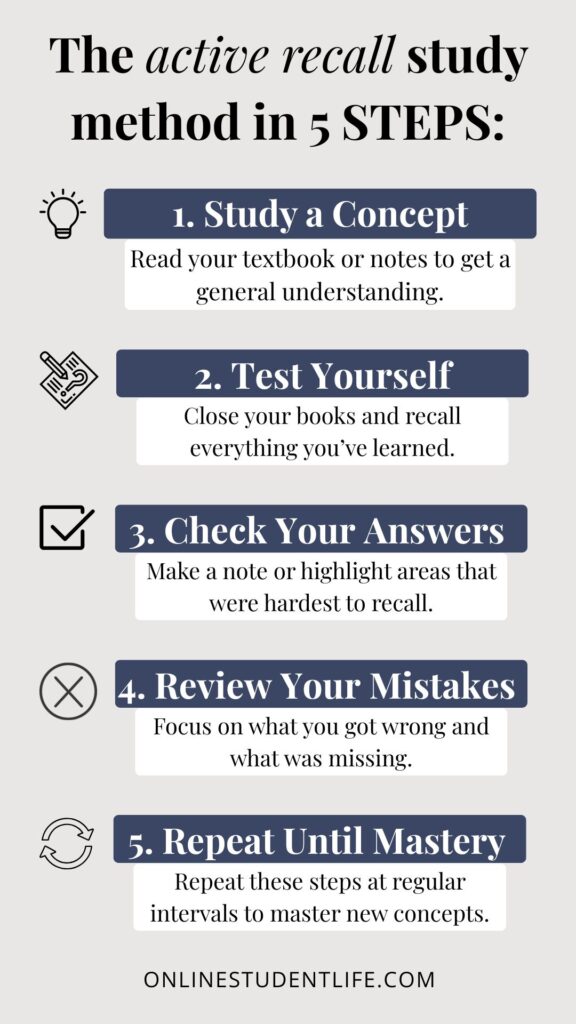
Active recall is broken down into 5 steps:
- Study a concept: Read your notes, watch a lecture or go through a section of your textbook to get a general understanding.
- Test yourself: Close your books and recall everything you’ve learned. Try to explain key concepts, definitions or steps in your own words.
- Check your answers: Go back to the study material and see what you got right, wrong or missed. Make a note or highlight areas that were hardest to recall.
- Review your mistakes: Focus on what you got wrong and what was missing.
- Repeat: Repeat these steps at regular intervals to master new material.
Active Recall Study Techniques
There are many ways to use active recall study techniques, so experiment until you find ones that work best for you!
Use Flashcards
Remember those flashcards your elementary school teacher used to teach you simple math and the alphabet? Turns out they were onto something—a lifelong study skill.
Make your own flashcards to pump up your learning, wether that’s by hand or by using one of my favorite flashcard apps – Quizlet.
See the post How to Make Effective Flashcards for Studying Using Index Cards to learn to make paper flashcards at home.
You can use flashcards by yourself or with friends, family or classmates. By repeatedly testing key terms and topics, you’ll imprint them in your memory.
Take Practice Tests and Quizzes
Don’t wait until you take the real test to find out where the gaps in your knowledge are.
Practice tests quickly pinpoint your weaknesses and let you know how well you’ve retained information. When you know where your issues are you can focus on concepts you need to master, saving time studying material you already know well.
Summarize Material From Memory
After studying or a lecture, write out a summary of the material you studied. By actively recalling and writing the information down, you are much more likely to remember it.
Teach the Concept to Others
Teaching concepts to others is done through peer tutoring or by using a study method called the Feynman Technique.
The Feynman Technique is a 4-step study method in which you explain a concept in simple terms to someone who has no background knowledge in it.
TIP: Ever had someone ask you how class was only for you to answer “fine”? Next time, tell the person who asks in detail what you learned that day – it will help you remember exactly what you learned!
Incorporate Spaced Repetition
Spaced repetition is a study technique where you review information at gradually increasing intervals over time to strengthen long-term memory.
For example: review new material the next day, then 3 days later, and then weekly until you write the exam. This makes studying for exams SO much faster!
Use Blurting
Blurting is a short spurt where you write down everything you know about a single topic from memory, and then check what you missed.
Frequently Asked Questions
Below are some of the most frequently asked questions by students about using active recall for studying – and questions I had when I first started using it.
How to Practice Active Recall While Studying?
The best way to practice active recall while studying is to use active recall study techniques such as:
- Doing practice tests.
- Summarizing material from memory.
- Using flashcards.
TIP: I like to start each study session with 30 minutes of reviewing previous material.
What Subjects Suit Active Recall Best?
Active recall works best for subjects that require a high amount of memorization (like terms) or application (like math questions). For example:
- Science (Biology, Anatomy, Chemistry, Physics): Great for memorizing definitions, processes, formulas and systems.
- Mathematics & Accounting: Instead of rereading solutions, re-solve problems from scratch.
- Languages: Perfect for vocabulary or grammar rules. I love it for verb conjugations as I self-study French.
- History: Test yourself on timelines, key events, causes/effects and historical figures.
- Medical & Health Sciences: Use for memorizing body systems, drug names or diagnostic criteria. Many medical students use flashcards daily for this reason.
What is The Active Recall App for Studying?
There are several apps you can use for active recall:
- Quizlet: Lets you create or use pre-made flashcard sets, practice tests and games. This is my favorite because I’ve seen a few of their practice questions on my math exams.
- Anki: A powerful, highly-customizable flashcard app that uses spaced repetition to help you remember material long-term.
- Gizmo: Uses AI to automatically turn your notes/PDFs into flashcards or quizzes for you to self‐test – helpful when taking multiple courses.
What Are the Disadvantages of Active Recall?
The biggest disadvantage is that using active recall study techniques (like making flashcards and doing practice tests) are time consuming.
It’s also mentally tiring. Remember to rest, or use the Pomodoro Technique to easily schedule in regular study breaks.
What Are Some Examples of Active Recall?
Some examples of using active recall to study are:
- Answering questions on practice tests.
- Testing yourself with flashcards.
- Answering end of chapter questions without looking at the answeres.
- Explaining a concept to either someone else or out loud (the Feynman Technique).
Is Active Recall Better Than Cramming?
Yes! Active recall is better than cramming because it strengthens long-term memory by forcing your brain to retrieve information and not just recognize it.
While cramming leads to quick, short-term recall, active recall helps you actually understand and retain what you’ve learned far beyond the exam – which you’ll need for higher level degree courses or graduate studies.
As a college student myself, I NEVER recommend cramming – I tried it so you can learn from my mistake!
Learning Actively is More Effective
Active recall for studying takes more effort than rereading your notes, but the payoff is 100% worth it.
It helps you actually learn the material, not just recognize it – and that’s exactly what you need to build exam confidence.
Start small by adding short recall sessions into your study routine. I like to start each study session with 30 minutes of recalling previous material, and over time you’ll notice how much easier it becomes to remember what you study.
Have any of these methods worked for you? Share your favorite way to study with active recall in the comments!
If you found this post helpful, sign up for my email list below and follow me on Instagram and Pinterest to join our online student community – you don’t have to go through your study journey alone!


