

Last Updated on January 19, 2026 by Alexandra Markin, Dip.Mgmt.St.
Looking to make flashcards at home for studying? They’re an easy and effective study method, and knowing how to do it the right way can make a huge difference in your grades.
For both high school and college students, flashcards are one of the best study tools for memorizing short chunks of information like vocabulary, terms and mathematical formulas.
In this post I’ll show you how to make the most effective DIY flashcards for studying at home using physical, paper index cards.
What You Need to Make Flashcards
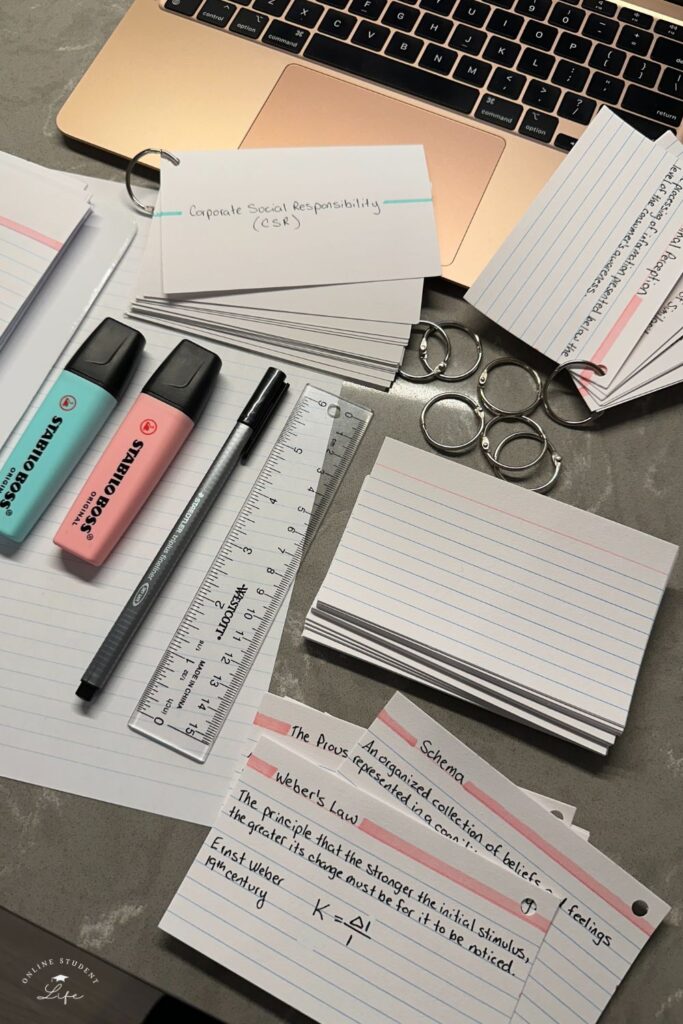
You don’t need many supplies to create effective and aesthetic study flashcards:
- 3″ x 5″ white index cards (blank on the front, lined on the back)
- 1″ binder rings
- Single hole punch
- A black pen (I like using my Staedtler 0.3mm triplus fineliner)
- Highlighters for color-coding (optional)
How to Make Flashcards for Studying Using Index Cards in 4 Easy Steps
Below I use flashcards I made for my 4th year college consumer behavior course to help me memorize terms and key concepts.
1. Decide What Information to Put on Your Flashcard
Flashcards work best when they’re used for short chunks of information you need to actively recall, and not long explanations that are better explained in your notes.
Information that works best on index card flashcards include:
- Short concepts that can be explained in a few lines.
- Definitions and key terms.
- Vocabulary words (especially for language-heavy courses).
- Formulas and equations.
- Important dates, names or facts.
Flashcards are NOT the place for:
- Long paragraphs or full textbook explanations.
- Entire lecture slides copied word-for-word.
- Complex processes that require multiple steps.
- Anything that requires so much text that you have to squint to read it.
If you’re running out of space on a card, that’s usually a sign the information belongs in your notes, not on a flashcard. Keep each card focused and simple to make flashcards most effective.
2. Put the Prompt on Front and the Answer on Back
How you use each side of your flashcard matters. The front of the card should prompt your brain to recall, not just recognize information.
On the front of the flashcard, write:
- A question
- A key term
- A prompt (like “Explain…” or “What is…?”)
This forces you to actively recall the information. You don’t want to passively flip cards and say to yourself, “Oh yeah, I know that” and then cruise by.
On the back of the flashcard, make the answer:
- Short and to the point.
- Written in your own words (if possible).
- Limited to only what you need to remember.
The goal isn’t to cram as much information as possible onto the back. It’s to give yourself a clear, QUICK check to see whether you truly know the material. Less text = better recall.
3. Color-Code Strategically
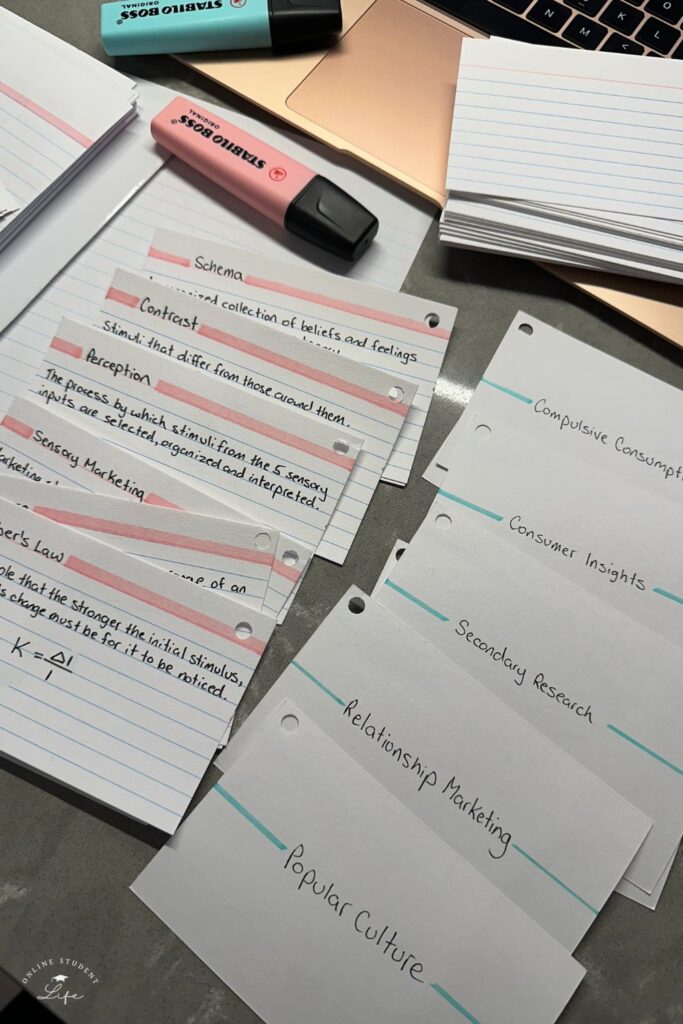
This can be different for each course or even each chapter. For my consumer behavior course, the textbook was divided into 4 sections, so I used 4 different colors on my flashcards—one to represent each section: blue, pink, green and orange.
You could even use pretty colored pastel index cards, using one color per chapter.
Using a highlighter, draw a line on either side of the term on the front of the flashcard, and then again on either side of the header on the back of the flashcard.
Get creative with how you use color, but don’t overdo it as it can be more distracting than efficient.
4. Assemble Flash Cards for Each Chapter or Section
When organizing and storing flashcards, keep each chapter or section together.
- Punch a hole in the top left corner of the card.
- Clip cards together using a 1″ binder ring.
When you use the cards for revision, simply unhook the binder ring to test yourself!
How to Make Your Study Flashcards Aesthetic
As a college student, I find that taking a few extra minutes to make my study flashcards aesthetically pleasing helps me study better.
Start by writing as neatly as possible. All the aesthetic flashcards you see on Pinterest that have beautifully written key terms and headings use either hand lettering or calligraphy.
It’s easier to learn than you think. Grab a hand-lettering and calligraphy practice book for beginners and a set of calligraphy pens and spend an afternoon developing a new skill you’ll have for life!
Using colors that go together, like pastel highlighters or a set of pastel-colored index cards to help tie the aesthetic together.
Wrap Up: Making Flashcards That Work for You
Flashcards don’t have to be complicated to be effective. When you’re intentional about what you put on each card and how you use them, using physical, paper index cards for flashcards can become one of the most reliable study methods in your routine.
For me, learning how to make flashcards for revision to compliment my notes created a way to help me actually engage with the material by using active recall, which made a noticeable difference in both my confidence and exam performance.
Start small and adjust and add more information as you go. Don’t stress about making them “perfect” if you’re just starting out. This naturally comes later by refining your system with the more you practice you get.
Drop a comment below and share what’s worked (or hasn’t worked) for you. I’m always looking for new ways to make my studying methods better!


