
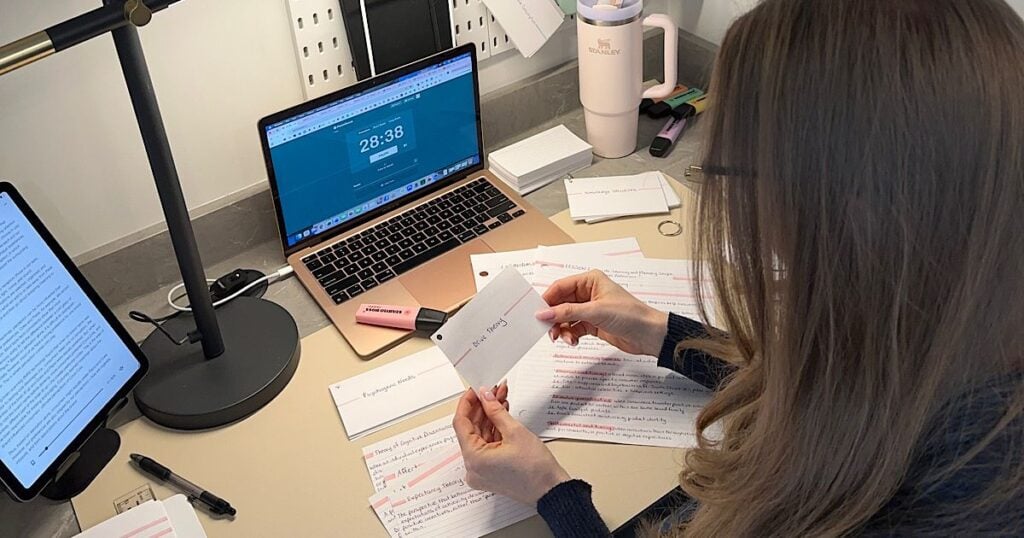
Last Updated on March 9, 2026 by Alexandra Markin, Dip.Mgmt.St.
Learning how to study smarter and not harder is actually an acquired skill in college—one that’s built over time through practice, strategy and experience.
As an online student, it took me a while to realize that spending hours at my desk rereading my textbook and taking detailed notes isn’t the same thing as actually learning. I thought “There’s got to be ways to study better. I feel like I’m taking way too long.” Good news—there are!
So if you’ve ever closed your laptop after a long study session and thought “What did I even learn?” it’s NOT because you’re bad at studying. Most of us (myself included) were never taught how to study smarter in the first place.
I’m sharing my proven tips to help you retain more information, feel less overwhelmed and use your precious study time in a way that actually works.
How to Study Smarter and Not Harder
1. Use the Active Recall Study Method
Active recall is a study method where you test yourself instead of passively rereading your notes or the textbook—making yourself “actively recall” the information you’re learning.
LEARN THE ACTIVE RECALL METHOD RECALL: How to Use Active Recall for Studying
My top 3 active recall techniques are:
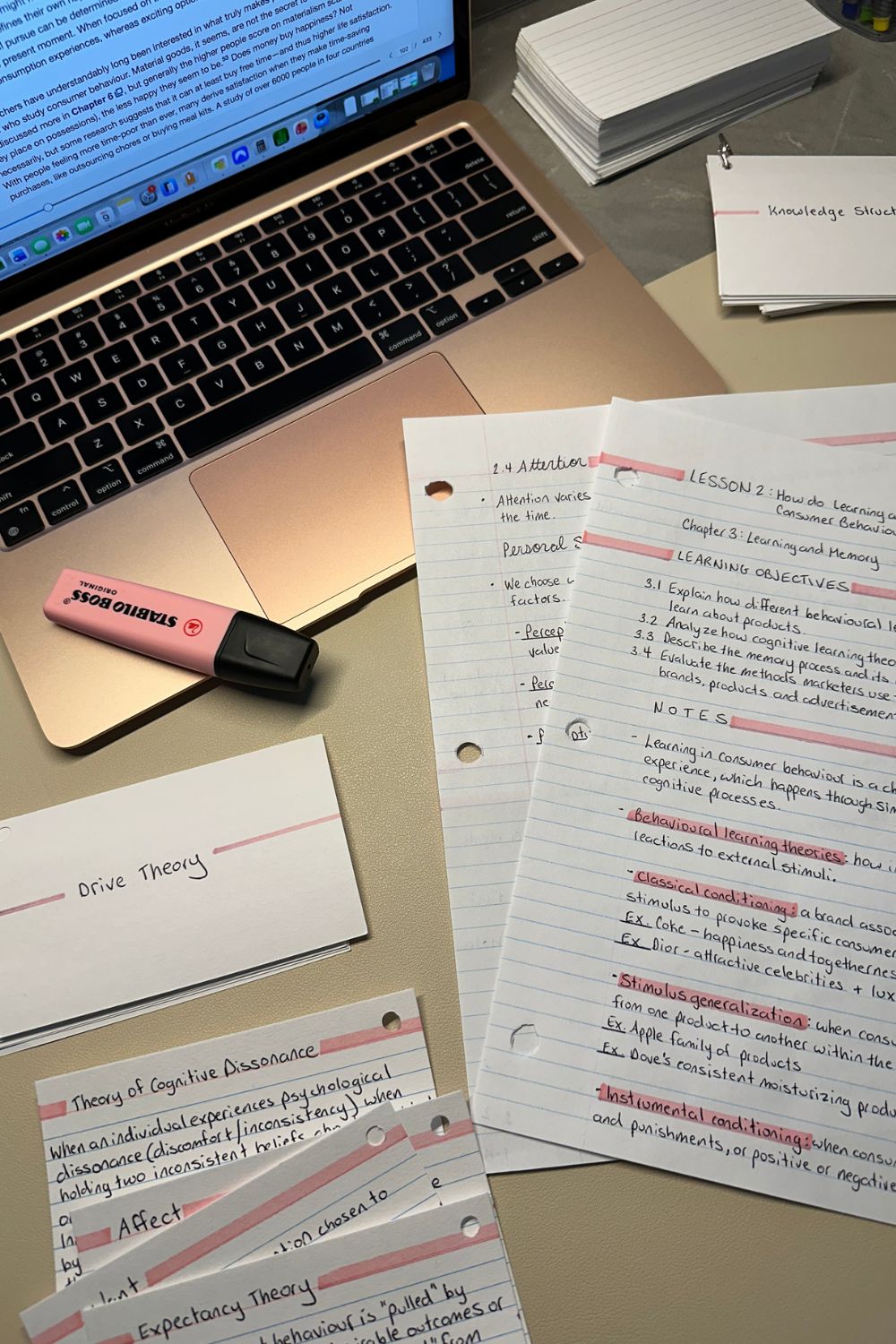
- Creating study flashcards. This works really well for courses with a lot definitions or short concepts you need to memorize.
- Doing practice questions. Great for math courses where practice is key, and courses that have short answer questions on the exam. If your course has “Review Questions” for each module—do them.
- Using The Feynman Technique. Teaching the material out loud, whether to yourself or another person (or your pet!) is called The Feynman Technique. If you can’t explain it to them simply, you don’t understand the material yet.
At first it can feel way harder than just rereading, but the effort of recalling is exactly what your brain needs to do during exams.
2. Use Spaced Repetition for Revision
One of my best revision tips is to use spaced repetition—reviewing material at gradually increasing intervals instead of cramming all at once. This method helps your brain move information from short-term memory to long-term memory, making recall on exams much easier.
For example, here’s how I used the 2357 spaced repetition study technique to learn the 22 vocabulary/short concepts for chapter 4 in my Consumer Behavior course, using study flashcards I made:
- DAY 1: Create flashcards for all 22 terms.
- DAY 2: Quiz myself on all 22 terms.
- DAY 3: Quiz myself again on all 22 terms, focusing on the ones I got wrong.
- DAY 5: Quiz myself again on all 22 terms, focusing on the ones I got wrong.
- DAY 7: Quiz myself again on all 22 terms, focusing on the ones I got wrong until I get none wrong.
LEARN TO MAKE STUDY FLASHCARDS: How to Make Effective Flashcards for Studying Using Index Cards
3. Create a Weekly Study Schedule
It may sounds obvious, but creating a study schedule (and sticking to it) is a big part of how to study smarter. Use time blocking each week for when you will study, and make it non-negotiable.
Do you study best first thing in the morning? Block off 2-3 hours of focused time. Are you a night owl? Set aside time to study at night without distraction.
I study best in the morning, so every day looks the same. I get up, make a coffee for studying and sit at my desk and get to work. And unless I have an appointment, I do this every single day.
When you have a consistent study routine, you spend less time feeling overwhelmed and more time actually making progress.
4. Work on Hardest Tasks First
You may feel like putting off starting that big assignment or the confusing math concept because deep down it scares you—for fear of getting a bad grade or using avoidance because it feels difficult or stressful. I get it. This happens to me several times a week, and I’ve learned it’s only because that “something” is new.
However, starting with your hardest subject or most challenging task may feel intimidating, but it’s one of the smartest ways to use your energy. Your focus and willpower are usually strongest at the beginning of a study session, so tackling difficult material first helps you make real progress before mental fatigue sets in.
Once the hardest task is done (or you’ve at least made a good start), everything else feels easier and your study session has actually moved the progress needle forward.
5. Set Clear Goals for Every Study Session
Break down each module into small, manageable tasks you can achieve each session.
For example:
❌ Study Consumer Behavior
✅ Read chapter 4 sections 4.1 & 4.2 and make study flashcards
Accomplishing set tasks (no matter how small) boosts dopamine and increases study motivation.
6. Don’t Make Notes for Every Subject
Wait, WHAT?! Contrary to what you might think, not every course requires pages and pages of detailed notes, and this can save you hours of time every week.
Some subjects are better learned using flashcards or doing practice problems rather than trying to rewrite the textbook. This will always be a personal call as to how YOU learn best.
Before automatically assuming you need to make detailed notes, ask yourself “Is this the most effective way FOR ME to learn this subject?” Studying smarter means choosing the method that actually helps you understand the material, rather than wasting time doing something that only appears productive.
However, if you need to take detailed notes because that’s how you learn best, by all means do it. I pretty much copied out the textbook in my Statistics for Business and Economics class because to me, the subject matter was so difficult my brain needed all the extra practice it could get.
7. Use the Pomodoro Technique
The Pomodoro Technique is one of the easiest time management strategies to improve focus.
LEARN THE POMODORO TECHNIQUE: How to Use the Pomodoro Technique for Studying
You work for a short amount of time (25–50 minutes), then take a short 5–10 minute break before starting another round. Breaks are really important when studying to avoid burnout and improve retention. It’s also not good for our bodies to sit for hours on end.
This is also my favorite technique to use to study when you don’t feel like it.
8. Eliminate Distractions
You know what distracts you, so remove the problem before you start studying. Whether it’s the temptation to check your email, scroll on social media or turn on Netflix, our distractions prevent us from studying smarter.
- Use a focus app like Forest to stay off your phone, or put it in another room on silent.
- Mute all notifications on your laptop and close all irrelevant tabs.
- Turn off the TV.
9. Use Digital Study Apps
In this digital age there are so many apps, websites and tools that can help you study smarter. From popular flashcard generators like Anki, self-testing apps like Quizlet and authorized academic journal websites that make essay research a breeze, there is something for every subject and student.
Take some time to experiment to find what helps you study best.
MY TOP RECOMMENDED APPS: 19 Free Online Study Apps, Tools & Websites for College Students
10. Gamify Studying
To “gamifying” studying means adding game-like elements to your study routine to make learning more fun, engaging and motivating. Use productivity apps like Habitica to track study goals, earn rewards and join challenges. It turns real-life into a video game by encouraging you to get more done!
You can also reward yourself after completing big tasks like assignments or after checking off a set amount of tasks.
11. Change Up Your Study Environment
If your brain likes change, studying in the same environment day after day can be stagnating. Rotate your desk with a cafe one day and a public library then next.
Take this as permission to hit up that cute coffee shop, order the aesthetic latte and prepare to study smarter!
12. Take Strategic Breaks (and Days Off)
You can’t study for hours on end without a break. Take an hour or two to eat, relax or do a hobby you enjoy. You’ll have improved focus and increased motivation to keep going.
Once in a while, you’ll feel like you need a day off from studying. This isn’t a sign of weakness—it’s taking strategic rest and allowing your brain to process what you’ve learned, even if you’re aren’t actively thinking about it.
13. Take Care of Yourself to Avoid Burnout
I’ve tried to power through and study as many hours as possible, but I always end up burning out. We’re all just human beings, and unfortunately we can’t function as robots no matter how much coffee or energy drinks we consume.
You don’t need to do anything fancy, just cover the basics:
- Get enough sleep (to help retain what you learn)
- Eat fairly healthy (your brain needs nutrients to fuel it properly)
- Get some daily movement (to get blood flowing)
- Incorporate basic hygiene: (shower, brush your teeth, wear clean clothes)
SEE ALSO: 10 Tips to Stay Healthy as a College Student
Study Smarter, Not Harder: Your Quick Takeaway
When learning how to study smarter and not harder, the key is to focus on strategies that help you truly understand and retain the material instead of simply spending more hours at your desk.
Try these strategies during your next study session:
- Use active recall techniques.
- Study in short, focused sessions.
- Take strategic breaks.
- Reward yourself for progress.
You got this!
Do you have a favorite way to study smarter? Share it below in the comments!


